
Departmental Seminar
Feb
13
2026
Feb
13
2026
Description
Inorganic nutrients determine not only phytoplankton production but also the productivity at higher levels of marine food webs including fishes of commercial importance. Despite their relevance in the functioning of marine ecosystems and as tracers of water movement, studies of nutrients in offshore waters of the deepest region in the Gulf of Mexico in the Mexican Economic Exclusive Zone are scarce. As part of the CIGoM (Consorcio de Investigación del Golfo de México) project, a baseline study of inorganic nutrients (nitrate+nitrite, NN; phosphate, PO4; and silicic acid, H4SiO4) was carried out in the deep-water region (>1000 m) of the Gulf of Mexico (GoM) in the Mexican Exclusive Economic Zone. During oceanographic campaigns (XIXIMI-04 to XIXIMI-07) carried out during the warm seasons from 2015 to 2018, water samples for nutrient analyses were collected from the surface down to near the bottom, at stations spanning from the Yucatan Channel to the Bay of Campeche at the southeastern GoM. In this seminar, a synthesis of the results of these campaigns will be presented, focusing on features characteristic of different water masses including (1) the enrichment of nutrients, particularly H4SiO4, between 1200-4000 m (the domain of the Upper North Atlantic Seawater); (2) the (slight) uncoupling in the NN and PO4 maximum at the core of the Antarctric Intermediate Water; (3) the strong influence of mesoscale eddies on the vertical distribution of nutrients in intermediate (300-1000 m) and upper (0-300 m) water masses. The contrast in the availability of nutrients in the euphotic zone between cyclonic and anticyclonic (Loop Current Eddies) will be discussed, as well as results of the distribution of nutrients in a recently detached Loop Current eddy sampled with high spatial resolution during 2022 during the PHYTBLOOM Eddy campaign.
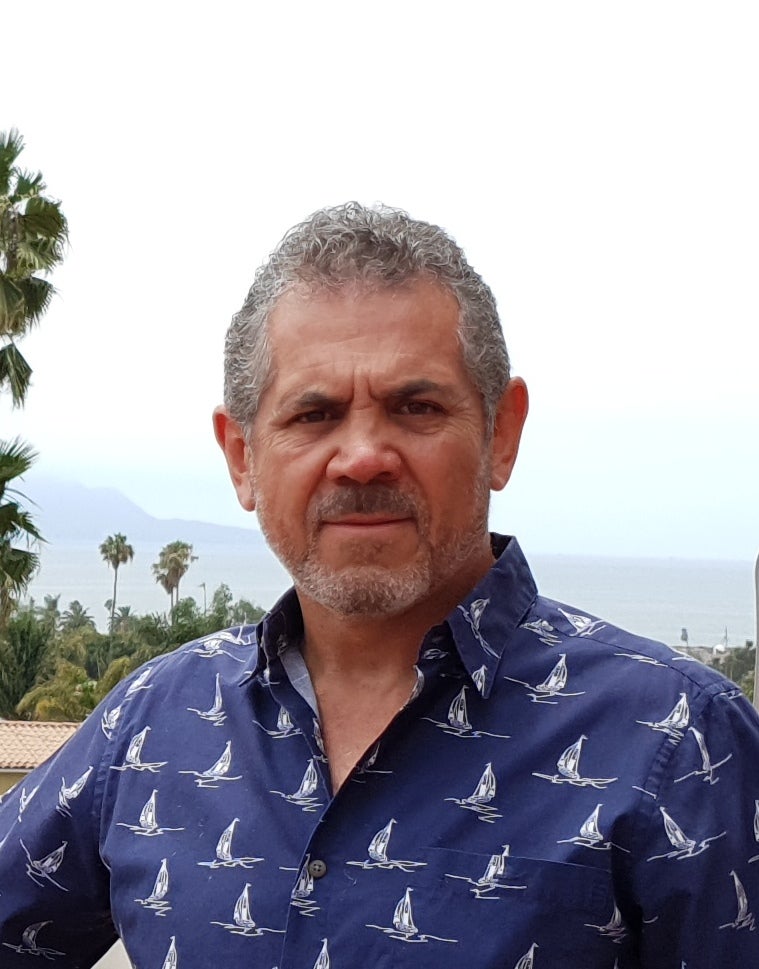
Víctor F. Camacho Ibar is a full-time research scientist at the Instituto de Investigaciones Oceanológicas (IIO) of the Universidad Autónoma de Baja California (UABC), Mexico. He earned a bachelor’s degree in Oceanology from UABC, a master’s degree in Marine Ecology from CICESE, and a Ph.D. in Oceanography from the University of Wales–Bangor (United Kingdom) in 1992. Since 1992, Dr. Camacho Ibar has been a full-time researcher at IIO-UABC in the area of Marine Biogeochemistry and Global Change, where he leads the CiNEMa (Ciclos de Nutrientes en Ecosistemas Marinos) research group. His early research focused on nutrient biogeochemistry in coastal lagoons, particularly the nitrogen cycle in San Quintín Bay—an eelgrass-dominated lagoon influenced by upwelling and oyster farming activities. He also participated in the LOICZ-IGBP project as the Regional Mentor for Latin America, working on nutrient budgets across the region. Over the past decade, his research has concentrated on nutrients and dissolved organic carbon in the deep waters of the Gulf of Mexico, with an emphasis on assessing the potential environmental impacts of deep-water oil spills. This work has expanded into studying the influence of mesoscale eddies on nutrient distribution and their relationship to primary production. In addition to his research, Dr. Camacho Ibar has served as a professor of Marine Chemistry and a thesis advisor in the Coastal Oceanography Graduate Program at UABC since 1992. He is a Level III member of Mexico’s National Researchers System (SNII) and received the Emeritus Researcher Award from UABC in 2025.