Next‑Generation Research Vessel to Expand Texas Coastal and Gulf Science
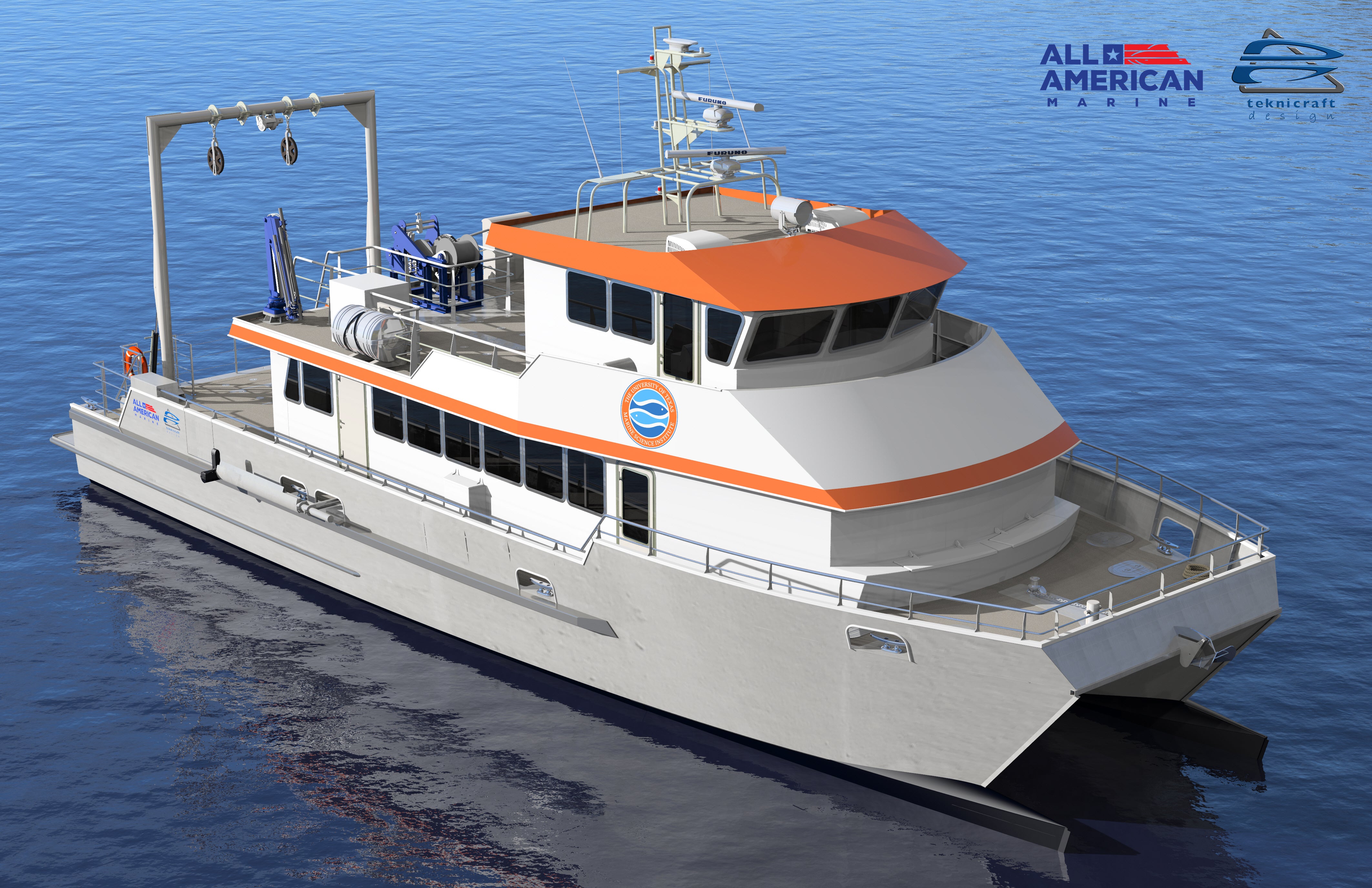
Rendering of the new vessel under construction. Credit: All American Marine.
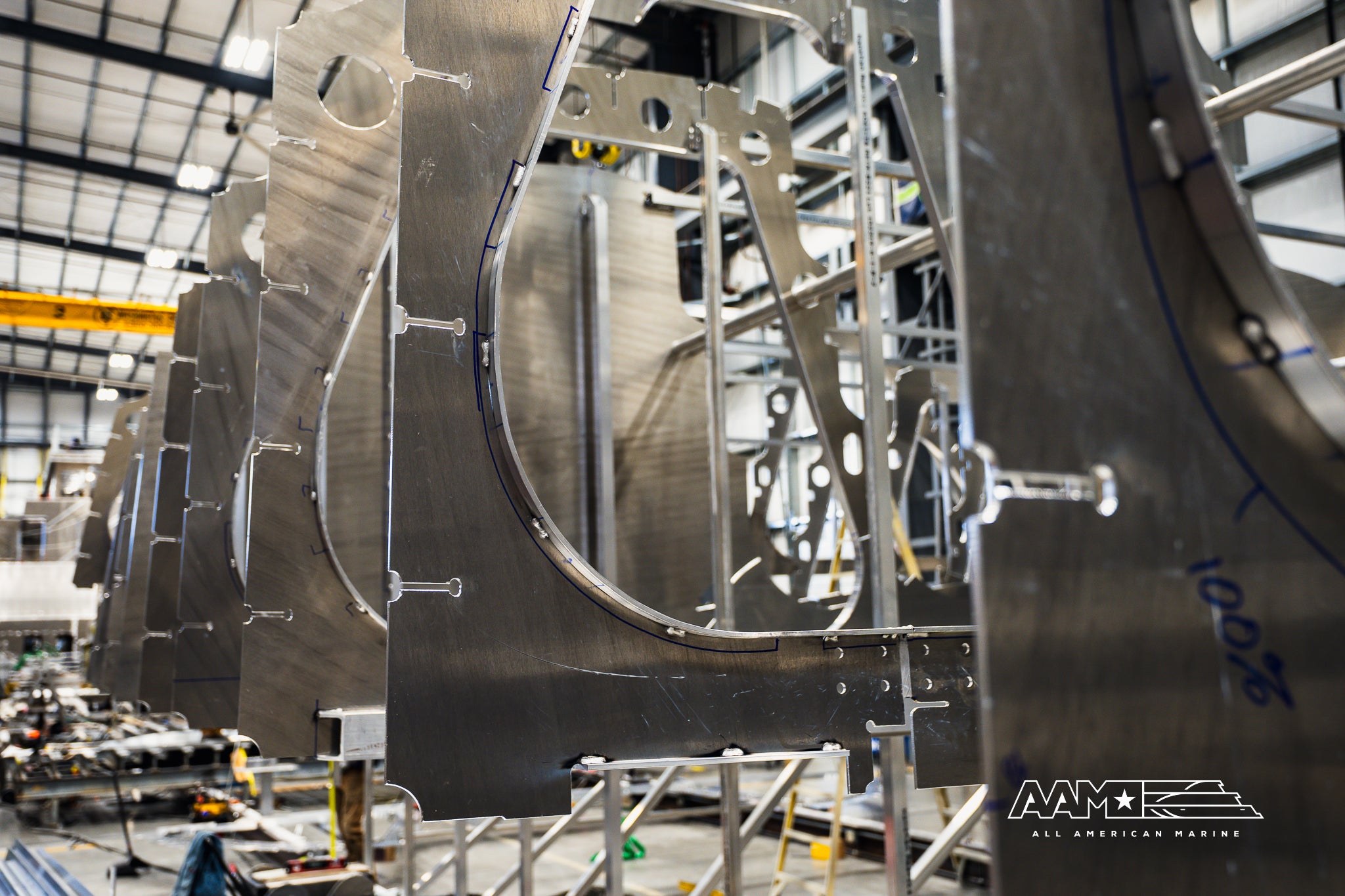
The first frames of the hull are under construction. Viewed here are the hull plating or external skin of the vessel. Credit: All American Marine.
Construction has begun on a new research vessel for the state of Texas and The University of Texas at Austin, Marine Science Institute (UTMSI). With support from the 88th and 89th Texas Legislature, UTMSI has commissioned All American Marine to collaborate on a design and complete the construction of a next-gen 78-foot by 26.7-foot aluminum catamaran research vessel. All American Marine is based out of Washington state but has experience creating vessels for Texas waters. In fact, UTMSI saw this experience firsthand with a similar vessel, the Captain Murchison, which is a Texas Parks and Wildlife Department’s (TPWD) coastal law enforcement vessel that was docked in the UTMSI marina for several years.
The reason why the design is so ideal for the Gulf is its fuel efficiency, fast speeds, and ample space on the deck, be it for a holding cell in TPWD’s case or a laboratory in UTMSI’s case. The vessel will be constructed on Teknicraft Design’s proven multi-purpose research platform and is designed to support scientific research, survey, and teaching missions throughout the Gulf of America, including offshore operations up to 150 nautical miles from shore.
Research along the Texas coast and the greater Gulf has been lacking for decades because the existing vessels available are in other states and are expensive to bring to Texas. Purpose-built for multi-mission flexibility, the twin-engine, prop-driven vessel will support a broad range of scientific operations, including coastal and offshore ecology research, seismic surveys, gravity coring, water chemistry analysis, fisheries surveys, and undergraduate and graduate instruction. “We’re excited that the Texas legislature saw the vision to launch a new era of coastal research and exploration with modern instrumentation and state-of-the-art equipment,” said Dr. Sharon Herzka, Associate Professor and Director of UTMSI.
The platform integrates an adjustable hydrofoil system, modular deck equipment, and dedicated wet and dry laboratory spaces to accommodate evolving research requirements across diverse operating profiles. The vessel is designed to carry up to 30 scientists, students, and crew on day trips, and up to 14 personnel on extended offshore missions. Operations will include near-shore research based out of Port Aransas, Texas, as well as multi-day expeditions across the Gulf of America. These missions will span near-coastal waters to deep-water environments, including the Texas shelf, the Mississippi, Trinity, and Sabine River Deltas, Salt Dome, and the Flower Garden Banks. “New discoveries await our UT researchers and also many others throughout Texas and the greater region,” said Herzka. The vessel will be added to the University-National Oceanographic Laboratory System (UNOLS) fleet, which will make it available to any institution to rent for research.
Powered by twin CAT C18 Tier 3 diesel engines producing a combined 1550 bhp, delivering cruising speeds of approximately 20 knots and fuel-efficient survey speeds as low as 3 knots. The vessel is defined by Teknicraft’s proprietary, adjustable hydrofoil system, which actively manages lift and drag, resulting in a smoother ride, lower fuel consumption, and consistent performance across a wide range of operating conditions. The resultant vessel is the most fuel-efficient hull in class.
“All American Marine is proud to partner with UTMSI on a vessel that brings together efficiency, flexibility, and proven performance,” said Ron Wille, President of All American Marine. “The Teknicraft platform allows a single vessel to support a wide range of scientific missions while maintaining the reliability and operational efficiency researchers depend on.”
To support this work, the vessel is outfitted with a flexible suite of scientific systems that allow researchers to collect water samples, study marine life, map the seafloor, and conduct geophysical surveys. Specialized equipment—including sampling systems, nets, seismic instruments, and coring tools—can be installed or removed as needed, allowing the vessel to be quickly reconfigured between research programs while maximizing time on the water.
“This vessel represents an investment not just in infrastructure, but in people, discovery, and Texas’s coastal future,” said Herzka. “By expanding access to modern, purpose‑built research capabilities, we’re empowering scientists and students to ask bigger questions, pursue new collaborations, and deliver the science needed for generations to come.”