Going in the Flow: New Theory on Why Some Carbon in the Ocean Sticks Around for Millennia
Study finds there is a significant fraction of tightly bonded water in dissolved organic matter and the bonded water can make it less available to microbes in the ocean
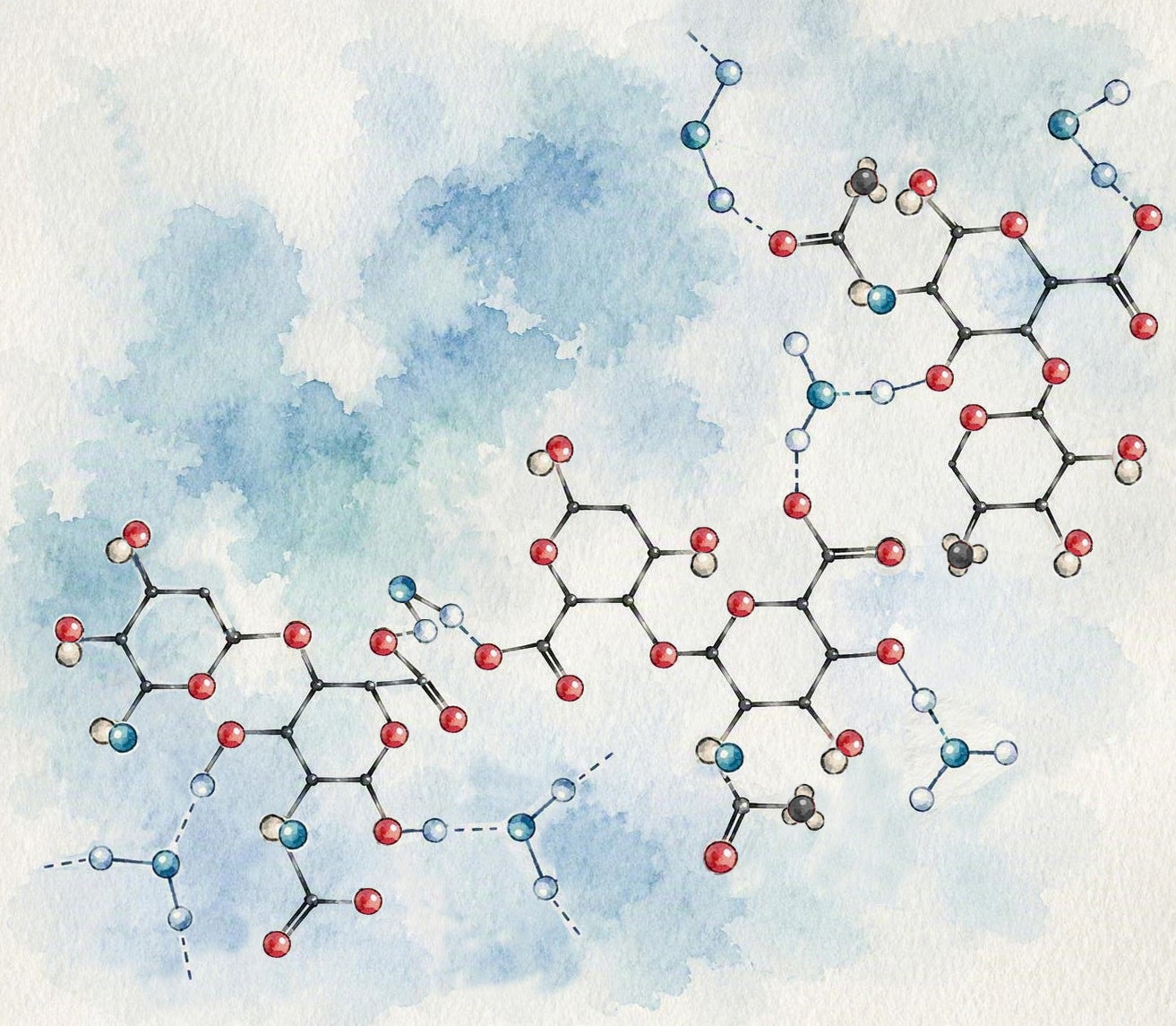
Artistic rendering of water bound supramolecule of high molecular weight, or heavy, dissolved organic matter. Illustration based on researcher-provided molecular drawings and created using digital illustration, generative AI-assisted rendering, and Adobe Photoshop. Credit: Sally Palmer/UT Austin.
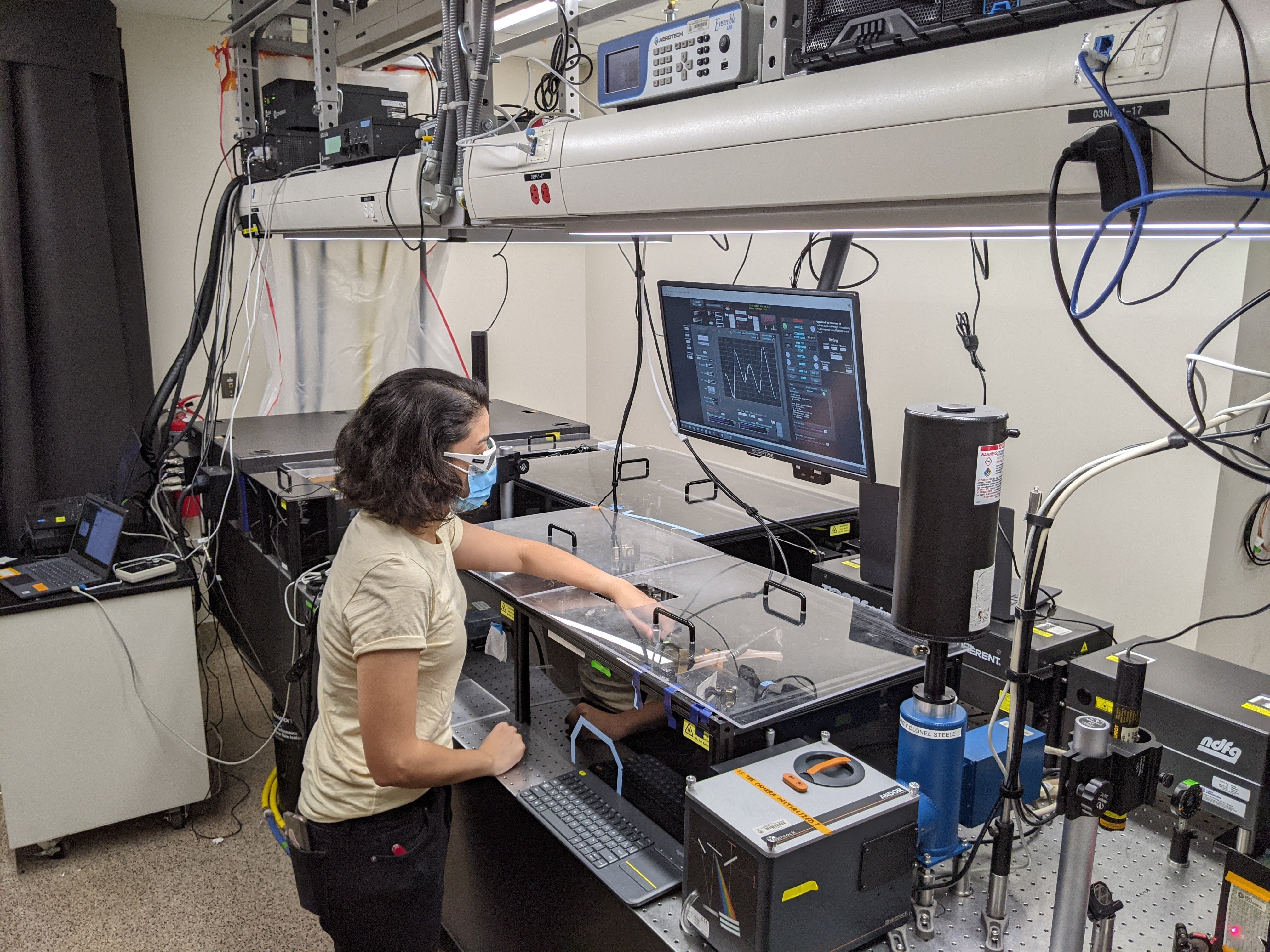
Ziareena Al Mualem, a graduate student at the time of the study, measures samples on a two-dimensional infrared (2D IR) spectroscopy, an advanced laser-based technique that can map how molecules and surrounding water molecules interact on extremely fast timescales. Credit: Carlos Baiz / UT Austin
The ocean contains one of Earth's largest reservoirs of reduced carbon in dissolved organic matter, which is roughly three-quarters as much carbon as is currently in Earth's atmosphere. Much of this reservoir remains in seawater far longer than scientists would expect because microbes do not readily consume it. A new study just released by Geophysical Research Letters and led by scientists at The University of Texas at Austin identifies a possible piece of that long-standing puzzle. The large, heavy dissolved organic matter that seems immune to microbial consumption may not be in the form of big molecules, but rather in the form of many small molecules that appear big because of their connections through bonded water. Researchers also found that some of that dissolved organic matter is less susceptible to microbes because they are bound by water in a supramolecule.
Dissolved organic matter plays an important role in the global carbon cycle, thus identifying mechanisms that influence its persistence can improve scientists’ understanding of how carbon is stored and transformed in the ocean. The researchers estimate that bonded water in a supramolecular form could account for about 3% by weight of total oceanic dissolved organic matter.
Historically hydrogen bonds in water are thought to be weak, but when they are in a supramolecule they act like a molecular glue when they are thousands strong and form tiny molecular bridges to each of the carbon pieces in the smaller molecules. “These molecules are not simply floating in water. The water appears to be part of the structure that holds the organic matter together,” said Zhanfei Liu, a professor at the University of Texas Marine Science Institute and the study’s corresponding author. “That structure may help shield portions of the organic matter from microorganisms.”
To investigate the role of bonded water, the team pulled together cutting-edge technology from different departments at The University of Texas at Austin and University of Wisconsin-Milwaukee. Using thermochemical and spectroscopic techniques, they were able to map the structures at the molecular level and applied both heat and drying to elucidate the structures to characterize how bonded water affect degradation by microbes.
The measurements showed that the bonded water required substantial energy to remove and was barely exchangeable with surrounding water under ambient conditions. Heating the material to 70 degrees Celsius removed the bonded water; in subsequent 60-day incubations, microbes consumed about 35% of the heated, water-depleted heavy dissolved organic carbon compared with about 21% of the untreated material.
Even freeze-drying these supramolecules didn’t make them fully dry. About 10% of the water by weight remained after freeze-drying, indicating that it is an integral part of the organic complex rather than ordinary moisture left behind during processing. The result suggests that removing that water may change the material’s conformation and expose portions that microorganisms can more readily consume.
“For decades, scientists have had different views of the apparent size and molecular structure of dissolved organic matter,” Liu said. “Bonded water offers a new mechanism that could help reconcile some of those differences and opens a new avenue for studying how this carbon-rich material persists and cycles through the ocean.”
The research was led by Kaijun Lu, now an Assistant Professor at Coastal Carolina University, and was conducted primarily at The University of Texas at Austin. Co-authors include Zhanfei Liu, Professor at the UT Austin Marine Science Institute; Xiao You, who conducted the research while at UT Austin and is now a postdoctoral researcher at Westlake University; Carlos Baiz, Professor in the UT Austin Department of Chemistry; and Laodong Guo, Professor in the School of Freshwater Sciences at the University of Wisconsin-Milwaukee. The study was supported by Texas Sea Grant, the Welch Foundation, the Freshwater Collaborative of Wisconsin, and the National Science Foundation.